

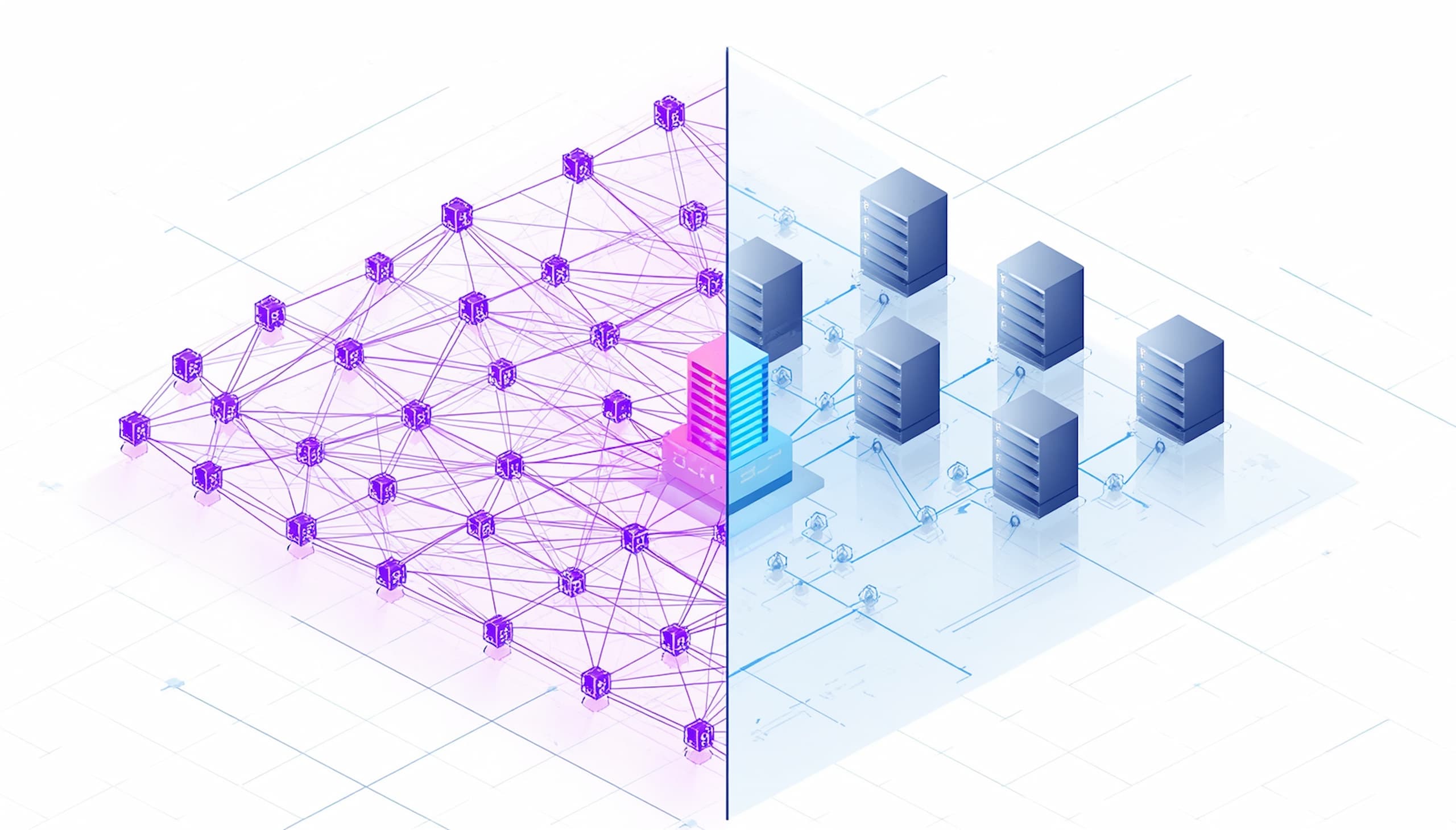
Web3 vs Web2: Must Know Differences in 2026
Web3 vs Web2 is the defining internet debate of 2026 — and the numbers are staggering. The global Web3 blockchain market is now valued at USD 4.97 billion and is projected to grow at a 43.21% compound annual growth rate through 2031 (Mordor Intelligence, 2026). While Web2 built the interactive internet we rely on daily, Web3 is engineering a decentralized replacement where users — not corporations — own their data, identity, and financial assets. In this guide, you will learn exactly how the two paradigms differ across architecture, data ownership, security, governance, and real-world investment impact.
What Are Web2 and Web3? Core Architecture Explained
Web2 is the version of the internet most Americans use every day — a centralized ecosystem of social media platforms, streaming services, and cloud applications run by corporations like Google, Meta, and Amazon. Every time you log in, your data travels to and lives on servers owned by these companies. Web2 emerged in the early 2000s and replaced the static, read-only Web1 with interactive, user-generated content.
Web3 replaces that centralized model with a decentralized network powered by blockchain technology. Instead of corporate servers, data is stored across thousands of distributed nodes, and users interact with applications through cryptographic wallets rather than usernames and passwords. As CoinDesk describes it, Web3 is “a decentralized online ecosystem where users have control over their data and transactions” (CoinDesk, 2026). The practical result: you become the custodian of your own digital identity and assets.
From Read-Write to Read-Write-Own
The clearest way to frame the Web3 vs Web2 distinction is through the evolution of user roles. Web1 was read-only — you consumed content. Web2 became read-write — you could post, comment, and share. Web3 introduces a third verb: own. Users on Web3 platforms hold genuine ownership of digital content through tokens, NFTs, and on-chain records. This shift dismantles the business model of surveillance capitalism that has powered Web2 platforms for two decades.
Authentication illustrates this perfectly. Web2 login flows depend on third-party providers — Google, Facebook, or Apple — creating dependency chains that can be revoked at any moment. Web3 replaces these with blockchain-based digital wallets and smart contracts, giving users sovereign identity that no corporation can suspend or delete. For more context on how Technology is reshaping authentication, explore our dedicated coverage.
Web3 vs Web2: Key Technical Differences
The fundamental technical gap between Web3 vs Web2 comes down to where data lives and who controls it. Web2 applications run on centralized server farms operated by AWS, Google Cloud, and Microsoft Azure. These providers store user data in proprietary databases with strict corporate access policies. Users agree to terms of service and effectively surrender data rights in exchange for free services.
Web3 protocols store data on distributed ledgers where no single entity holds control. Ethereum layer-2 solutions processed over 15 million daily transactions in early 2026, reducing costs by 95% compared to mainnet operations (The Block Opedia, 2026). Major corporations are now operating hybrid models — maintaining Web2 front-ends while leveraging Web3 infrastructure for supply chain transparency and digital asset management.
| Feature | Web2 | Web3 |
|---|---|---|
| Architecture | Centralized servers | Distributed blockchain nodes |
| Data Control | Platform / corporation | User via cryptographic keys |
| Authentication | Username and password (OAuth) | Blockchain wallet and signature |
| Payments | Banks, Stripe, PayPal (intermediaries) | Native crypto, smart contracts |
| Governance | Corporate decisions, unilateral changes | DAOs, token-holder voting |
| Transparency | Opaque, proprietary | Public ledger, auditable |
| Content Model | Read-write | Read-write-own |
Smart Contracts vs Traditional Agreements
In Web2, business logic lives in proprietary code running on corporate servers that users cannot inspect or verify. Web3 replaces this with smart contracts — self-executing code deployed on public blockchains that run exactly as written, with no possibility of unilateral modification by a central party. This removes the need to trust an intermediary, replacing it with trust in auditable code.
Payment systems are perhaps the most dramatic illustration of this difference. Web2 payments run through banking infrastructure and geographic restrictions, often charging 2-5% in transaction fees. Web3 value transfer is a native network feature: smart contracts can execute micro-payments, global transfers, and complex revenue-sharing arrangements in seconds, with fees measured in fractions of a cent on modern Layer-2 networks. Explore more about evolving payment systems in our Business & Finance section.
Data Ownership and Privacy: Where Web3 Wins
Data ownership is arguably the most consequential difference in the Web3 vs Web2 debate. Under Web2, when you create a social media account or use a free app, the platform collects, stores, and monetizes your personal data. You generate the value; the corporation captures it. A 2026 NordVPN survey found that 7 in 10 Americans have active security concerns about digital transactions and data storage (NordVPN, 2026).
Web3 inverts this relationship. Users maintain cryptographic keys that prove ownership of their data and digital assets. No platform can unilaterally delete, modify, or monetize your on-chain records without your cryptographic authorization. Over USD 250 billion in assets are now held in non-custodial wallets globally, reflecting growing investor trust in decentralized custody (CoinLaw, 2026). This figure signals that data sovereignty is no longer a theoretical concept — it is an active user preference.
Decentralized Identity vs Platform-Controlled Accounts
Web2 identity is fragile by design. Platforms can suspend, ban, or permanently delete accounts based on terms of service decisions, leaving users with no recourse and no way to recover their digital history. This has significant implications for creators, businesses, and anyone who has built an audience on centralized platforms. The risk is real: a single policy change at one tech giant can erase years of digital work overnight.
Web3 decentralized identity systems give users a persistent, self-sovereign digital identity anchored to a blockchain address. That identity cannot be revoked by a corporation, travels across different decentralized applications without re-registration, and can be selectively disclosed to protect privacy. As Web3 adoption grows, decentralized identity is becoming a foundational infrastructure layer for finance, healthcare, and governance applications. Read more about emerging digital identity trends in our Crypto & Web3 coverage.
Web3 Blockchain Market Analysis and 2026 Growth
The Web3 blockchain market has moved decisively from early-adopter hype to measurable economic weight. The global Web3 market is valued at USD 4.97 billion in 2026 and is forecast to reach USD 29.97 billion by 2031, reflecting a 43.21% CAGR (Mordor Intelligence, 2026). North America leads adoption with a 41.2% global market share, driven by institutional investment and regulatory development. The US market alone recorded a 42.8% CAGR in 2024, the highest of any major economy.
Banking, financial services, and insurance represent the single largest Web3 segment, accounting for 37.85% of market share in 2025 (Mordor Intelligence, 2026). JPMorgan expanded its JPM Coin to public blockchains; Société Générale introduced a euro stablecoin; and a consortium including PNC, Citi, and Wells Fargo is actively exploring a joint token initiative (CoinDesk, 2026). Silicon Valley Bank projected that M&A in the crypto sector will set a record in 2026 as digital asset capabilities become table stakes for financial services firms.
| Metric | 2026 Value | Source |
|---|---|---|
| Global Web3 Market Size | USD 4.97 billion | Mordor Intelligence |
| Market CAGR (2026-2031) | 43.21 percent | Mordor Intelligence |
| Assets in Non-Custodial Wallets | Over USD 250 billion | CoinLaw |
| North America Market Share | 41.2 percent | Market.us |
| Active Crypto Wallets Globally | 820 million unique (2025) | CoinLaw |
| Layer-2 Daily Transactions (Q1 2026) | Over 15 million/day | The Block Opedia |
| DeFi Share of Crypto Trading Volume | 35 percent | CoinLaw |
DeFi and Tokenized Assets Drive Web3 Differentiation
Decentralized finance (DeFi) is perhaps the most concrete demonstration of how Web3 outperforms Web2 in financial infrastructure. Web2 financial platforms require bank accounts, credit checks, geographic eligibility, and intermediary fees at every transaction layer. DeFi protocols on Web3 offer lending, borrowing, yield generation, and currency exchange to anyone with a wallet — no intermediary required. Decentralized exchanges now account for 35% of total crypto trading volume (CoinLaw, 2026), a share that was essentially zero just five years ago.
Tokenized real-world assets are adding another layer of differentiation. Institutional capital exceeding USD 100 billion flowed into DeFi protocols in 2024 alone, funding tokenized bonds, real estate, and commodities that unlock liquidity previously inaccessible to retail investors (Mordor Intelligence, 2026). California’s DMV digitized 42 million vehicle titles on blockchain as a government-level proof-of-concept that Web3 infrastructure is mature enough for large-scale public deployment.
What Experts Are Saying About Web3 vs Web2 in 2026
Industry leaders in 2026 are framing the Web3 vs Web2 transition not as a future possibility but as an active infrastructure shift already underway. Silicon Valley Bank analyst Anthony Vassallo stated that 2026 is “crypto’s integration year,” with traditional financial institutions accelerating adoption rather than risk disruption from Web3-native competitors (CoinDesk, 2026). The bank expects M&A to set a new record this year as digital asset capabilities become core requirements for financial services firms.
At CoinDesk’s Consensus Hong Kong 2026 event, a prominent debate emerged between Cardano founder Charles Hoskinson and Cysic’s Leo Fan over the limits of decentralization. Fan warned that blockchain projects relying on hyperscalers like Google Cloud risk recreating the centralized single points of failure that Web3 was designed to eliminate (CoinDesk, 2026). The exchange underscores that the Web3 vs Web2 debate is not binary — it is a spectrum, and the industry is actively navigating where the boundaries should lie.
Regulatory Clarity as a Web3 Growth Accelerator
One of the most significant 2026 developments in the Web3 vs Web2 landscape is the emergence of regulatory frameworks that give institutional players the certainty they need to commit capital. Europe’s MiCA regulation and emerging US stablecoin legislation are reducing uncertainty that previously kept major banks on the sidelines. Investment in stablecoin-focused companies surged to more than USD 1.5 billion in 2025, up from less than USD 50 million in 2019 (CoinDesk, 2026), a trajectory that reflects regulatory momentum translating directly into capital allocation.
Decrypt, the leading Web3 news outlet backed by ConsenSys, notes that Web3 is fundamentally a response to Web2’s unresolved privacy and data control problems — problems that no amount of policy reform within the Web2 model has fully solved. Regulatory clarity around blockchain technology effectively fast-tracks the institutional adoption that turns the Web3 vs Web2 debate from philosophical to practical. For more on regulatory developments, visit our Crypto & Web3 news hub.
Investment Considerations: Web3 vs Web2 Opportunities
From an investment standpoint, the Web3 vs Web2 comparison reveals a structural divergence in where value accrues. In Web2, value concentrates at the platform layer — shareholders of Google, Meta, and Amazon capture the economic surplus generated by billions of users. In Web3, value is distributed across network participants through token economics: users, developers, and validators all receive a share of the value they help create.
The Web3 blockchain market is projected to grow from USD 4.97 billion in 2026 to USD 29.97 billion by 2031 (Mordor Intelligence, 2026), representing a five-fold increase in six years. For American investors, the most accessible entry points span publicly traded crypto-native companies, blockchain ETFs, direct cryptocurrency holdings, and participation in DeFi protocols. The banking and financial services sector — with a 37.85% Web3 market share — is the largest institutional arena for Web3 capital deployment today.
Key Risks in the Web3 vs Web2 Investment Landscape
Web3 investments carry risks that differ materially from traditional Web2 technology investments. Smart contract vulnerabilities have led to significant protocol exploits; a wave of multisig-related hacks and operational misconfigurations caused catastrophic losses in the first half of 2025 (CoinDesk, 2025). Regulatory risk remains a factor in the United States, where stablecoin and DeFi frameworks are still being finalized. Investors should also note that only 12% of American adults currently use Web3 wallets (CoinLaw, 2026), meaning adoption — while growing rapidly — is still early-stage.
The most resilient Web3 vs Web2 investment thesis focuses on infrastructure plays: Layer-2 scaling networks, decentralized storage protocols, and cross-chain interoperability solutions that will be required regardless of which specific applications win market share. Web3 gaming, tokenized real-world assets, and stablecoin payment rails represent the three highest-growth subsectors by analyst consensus heading into the second half of 2026. None of this constitutes financial advice — always consult a qualified advisor before allocating capital to any digital asset class. Find related analysis in our Business & Finance section.
Final Thoughts
The Web3 vs Web2 debate in 2026 is no longer theoretical — it is a live infrastructure transition with USD 4.97 billion in market value, 820 million active wallets globally, and institutional capital from JPMorgan, Citi, and major banks now flowing on-chain. The core takeaway is this: Web2 optimized the internet for engagement and advertising revenue; Web3 is optimizing it for user ownership, transparency, and permissionless value transfer. For American investors and technology professionals, understanding these differences is now a baseline requirement. Stay ahead of the shift by following Crypto & Web3 developments and our broader Technology coverage at dailytrending.site.
What Do You Think?
Are you already using Web3 apps, or do you think Web2 still has the edge for everyday users? Drop your take in the comments below — and share this article with anyone navigating the blockchain revolution in 2026.
Frequently Asked Questions
What is the main difference between Web3 vs Web2?
The main difference between Web3 vs Web2 is control and ownership. Web2 operates on centralized platforms owned by corporations like Google and Meta, which control user data and monetize it through advertising. Web3 uses blockchain technology to create a decentralized internet where users own their data, digital assets, and identity through cryptographic wallets. The Web3 market is growing at 43.21% CAGR and is valued at USD 4.97 billion in 2026 (Mordor Intelligence, 2026).
Is Web3 blockchain technology actually being used in 2026?
Yes. Web3 blockchain technology has significant real-world deployment in 2026. Ethereum Layer-2 networks are processing over 15 million daily transactions, JPMorgan expanded JPM Coin to public blockchains, California’s DMV digitized 42 million vehicle titles on-chain, and decentralized exchanges now handle 35% of total crypto trading volume (CoinLaw, 2026). The Web3 vs Web2 transition is actively underway, particularly in banking, payments, and asset tokenization.
Can Web3 replace Web2 entirely?
A complete replacement is unlikely in the near term. In 2026, the prevailing model is convergence: major corporations are running hybrid architectures that maintain Web2 user interfaces while leveraging Web3 infrastructure for specific functions like payments, identity, and supply chain. Web3 blockchain excels in finance, digital ownership, and permissionless applications, while Web2 continues to lead in content delivery, social media, and consumer applications with lower technical barriers for average users.
How do I start using Web3 as a beginner in the US?
The entry point for most Americans exploring Web3 vs Web2 is setting up a non-custodial wallet such as MetaMask, which has over 30 million monthly active users globally (CoinLaw, 2026). From there, you can interact with decentralized applications, hold crypto assets, and explore DeFi platforms. Only 12% of US adults currently use Web3 wallets, meaning now is still an early-adopter window. Always research any platform thoroughly and start with small amounts given the volatility of digital assets.
References
- CoinDesk — From Wall Street to Web3: 2026 Is Crypto’s Integration Year, Silicon Valley Bank Says
- CoinDesk — Cysic Founder Challenges Charles Hoskinson Over Big Tech Partnership and Decentralization Ethos
- Decrypt — What Is Web3? A Decentralized Internet Via Blockchain Technology
- Mordor Intelligence — Web3 Market Size, Share, Growth and Industry Research Report 2031
- CoinLaw — Web3 Economy Statistics 2026: Market Growth Facts
- Market.us — Global Web3 Blockchain Market Size, Share and Industry Report