

Dollar Cost Averaging in Crypto: The Bullish 2026 Guide
Dollar cost averaging crypto has delivered returns exceeding 1,145% over seven years for disciplined Bitcoin investors — and in 2026, this strategy is more relevant than ever (Spoted Crypto, 2026). With the global crypto market cap sitting at USD 2.47 trillion (CoinMarketCap, 2026) and Bitcoin trading near USD 75,000 amid sharp institutional swings, timing the market has become nearly impossible for everyday investors. This guide explains exactly what DCA is, how it performs in 2026’s volatile environment, and how you can deploy it to build lasting crypto wealth.
What Is Dollar Cost Averaging in Crypto?
Dollar cost averaging crypto is the practice of investing a fixed dollar amount into a cryptocurrency — such as Bitcoin or Ethereum — at regular intervals, regardless of the current price. Instead of trying to buy at the “perfect” moment, DCA investors commit a set sum weekly, biweekly, or monthly on autopilot. This approach has been a cornerstone of traditional index-fund investing for decades, and it translates powerfully into the crypto space.
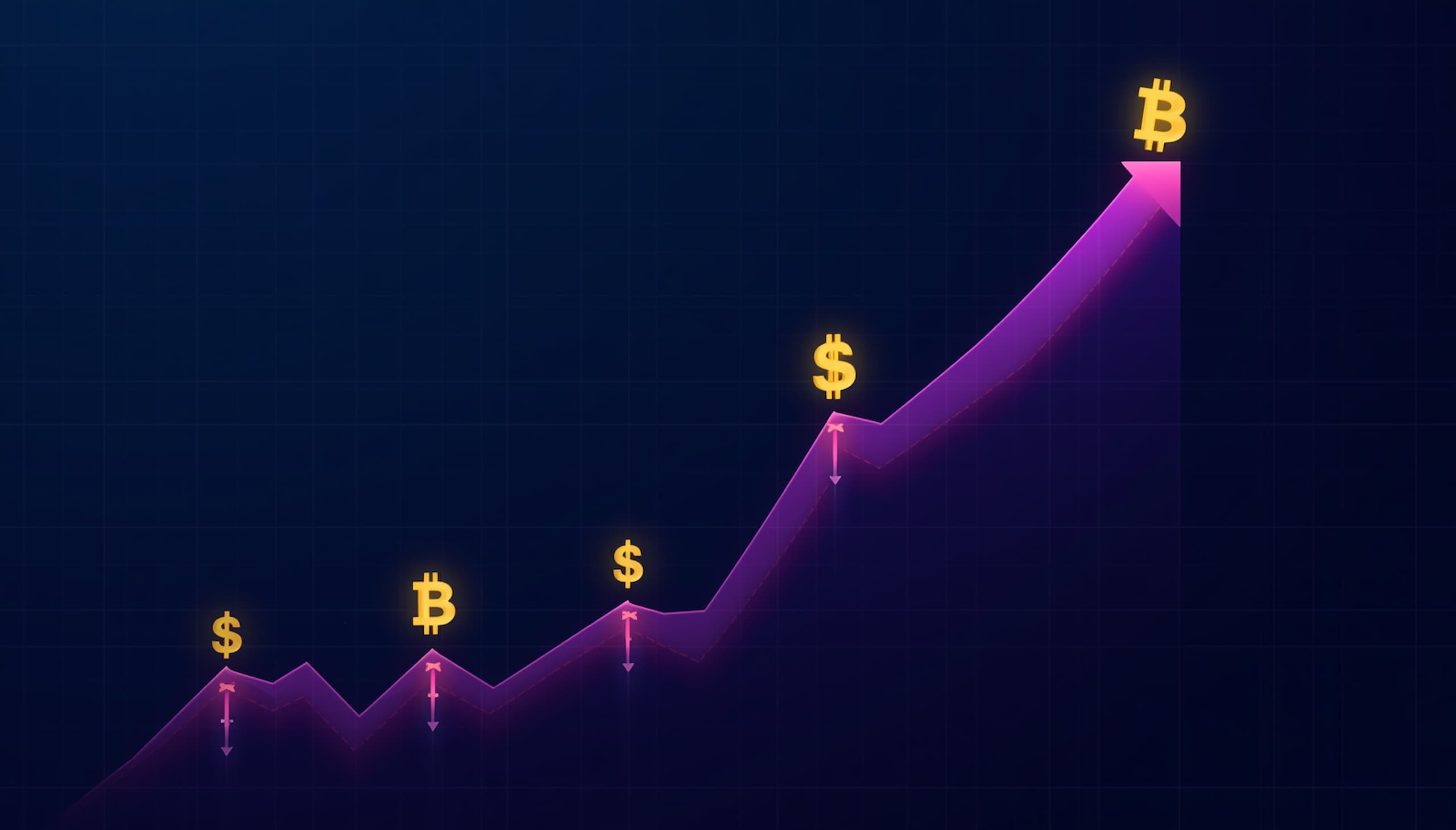
The core mechanic is simple but elegant. When prices are high, your fixed amount buys fewer coins. When prices crash, the same amount buys more. Over time, this smooths out your average cost per coin, removing the emotional guesswork that causes most retail investors to buy high and sell low. For a volatile asset class like crypto — where Bitcoin has regularly swung 5–15% in a single week (The Crypto Basic, 2026) — this discipline is especially valuable.
The Mechanics of DCA: A Simple Example
Consider a straightforward scenario: an investor puts USD 1,000 into Bitcoin every week from January through March 2026. Over that period, they commit USD 12,000 and accumulate roughly 0.15949 BTC at an average price of USD 75,239 per coin (The Crypto Basic, 2026). Had that same investor tried to time the market and bought in one lump sum at Bitcoin’s January 2026 peak above USD 126,000, they would currently be sitting on a significant unrealized loss.
This is the essential power of dollar cost averaging crypto: it converts the market’s wild swings from a threat into a tool. During bear markets, your fixed purchase buys more coins at depressed prices, setting up outsized gains when the cycle turns. For US investors building long-term crypto wealth, DCA is not just a strategy — it’s a framework for surviving and thriving across full market cycles. You can explore more investment strategies in our Business & Finance section.
Crypto Market Analysis: Why DCA Works in 2026
The 2026 crypto market is defined by a tension between institutional adoption and macro-driven volatility. Bitcoin touched an all-time high above USD 126,000 in October 2025 before pulling back sharply; as of late May 2026, it trades near USD 73,000–75,000 (CoinMarketCap, 2026). The global crypto market cap stands at USD 2.47 trillion, with Bitcoin commanding 59.6% dominance (CoinMarketCap, 2026). For investors trying to time this whipsaw market, the results have been brutal — which is exactly why dollar cost averaging crypto has regained center stage.
Institutional players have poured capital into Bitcoin ETFs regardless of short-term price action. U.S. spot Bitcoin ETFs have accumulated over USD 58.72 billion in cumulative net inflows since their January 2024 launch — making them one of the most successful financial product launches in history (Intellectia, 2026). Even major banks like Bank of America and BNY Mellon are now building Bitcoin exposure, underscoring the long-term conviction that underpins the dollar cost averaging crypto thesis.
Historical DCA Performance Data for Bitcoin and Ethereum
The historical data for dollar cost averaging crypto is compelling. A USD 10 weekly Bitcoin investment from 2019 through 2024 turned USD 2,610 into approximately USD 7,900 — exceeding a 200% return over five years (The Motley Fool, 2026). Zooming out further, disciplined weekly DCA into Bitcoin over seven years has returned roughly 1,145% by early 2026 (Spoted Crypto, 2026). As of 2026, every rolling three-year-plus DCA window for Bitcoin since 2013 has ended in profit — a remarkable track record across bear markets, exchange collapses, and regulatory crises (The Motley Fool, 2026).
Ethereum adds another dimension to the dollar cost averaging crypto playbook. Unlike Bitcoin, ETH allows DCA investors to stake their holdings and earn roughly 3% in annualized rewards, compounding their coin count over time (The Motley Fool, 2026). This is the crypto equivalent of dividend reinvestment — if Ethereum’s price recovers, holders benefit from appreciation on both purchased and earned coins. For investors in our Crypto & Web3 space, this dual return mechanism makes ETH an attractive DCA target alongside BTC.
| Strategy | Time Horizon | Total Invested (USD) | Approx. Return |
|---|---|---|---|
| Weekly DCA (USD 10/week) | 2019–2024 (5 years) | USD 2,610 | +202% (approx. USD 7,900) |
| Weekly DCA (USD 100/week) | 2019–2026 (7 years) | USD 36,400 | +1,145% |
| Lump Sum at 2022 Bear Bottom | Nov 2022 – 2026 | USD 20,000 | +340% (to approx. USD 88,000) |
| Lump Sum at 2026 ATH | Jan 2026 – May 2026 | USD 20,000 | -42% (significant loss) |
| Every 3-Year DCA Window (BTC) | 2013–2026 (all windows) | Varies | 100% profitable |
What Experts Are Saying About Dollar Cost Averaging Crypto in 2026
Veteran crypto investor Dan Tapiero, speaking to CoinDesk in January 2026, outlined why 2026 is structurally bullish for long-term Bitcoin accumulation. Tapiero cited falling interest rates and large-scale government spending driving currency debasement globally — conditions he called “very bullish for bitcoin” (CoinDesk, 2026). His view aligns directly with the dollar cost averaging crypto thesis: in an environment of fiat debasement, regular BTC purchases act as a systematic hedge.
On the institutional side, Bloomberg ETF analyst Eric Balchunas highlighted the resilience of Bitcoin ETF inflows even as prices declined, noting that BlackRock’s IBIT fund ranked among the top 11 ETFs by April flows with USD 2.3 billion — despite being one of the few on that list with a negative year-to-date return (Bloomberg / CryptoTimes, 2026). This institutional behavior mirrors the DCA principle: sophisticated money keeps buying at regular intervals regardless of short-term price action.
How Strategy (MicroStrategy) Applies DCA at Institutional Scale
Perhaps the most vivid large-scale example of dollar cost averaging crypto is Strategy (formerly MicroStrategy), chaired by Michael Saylor. Strategy began acquiring Bitcoin in August 2020 and has continued purchasing at regular intervals ever since. As of February 22, 2026, the company holds 717,722 BTC at an average cost of approximately USD 76,020 per coin — a total investment of roughly USD 54.56 billion (MEXC News, 2026). Even as Bitcoin fell nearly 50% from its October 2025 all-time high, Saylor publicly confirmed the company’s approach maps directly to dollar cost averaging crypto principles.
This institutional validation matters for retail investors. When the world’s largest corporate Bitcoin holder explicitly endorses disciplined, interval-based accumulation during drawdowns, it underscores that dollar cost averaging crypto is not just a retail coping mechanism — it’s a deliberate, evidence-backed wealth-building system. For more on the institutional forces shaping digital assets, see our coverage in the Technology section.
Investment Considerations: DCA vs. Lump Sum in 2026
The debate between dollar cost averaging crypto and lump-sum investing has a nuanced answer in 2026. In traditional equity markets, research has shown that lump-sum investing outperforms DCA roughly two-thirds of the time, since markets trend upward and deploying capital earlier captures more upside (InvestingWithAI, 2026). Crypto fundamentally changes this calculus — and the 2026 market is exhibit A.
An investor who deployed a lump sum into Bitcoin at the January 2026 all-time high above USD 126,000 is now sitting on losses exceeding 40%. Meanwhile, a disciplined DCA investor who began a weekly USD 100 purchase four years ago — through the FTX collapse, the 2023 uncertainty, the 2024 ETF rally, and the 2025 blow-off top — holds a substantially profitable position. The asymmetry is striking: lump sum investing in crypto can deliver spectacular wins if timed perfectly, but it can also be catastrophic. Dollar cost averaging crypto removes that binary risk entirely.
Key Risks and Limitations of Dollar Cost Averaging Crypto
Dollar cost averaging crypto is not without trade-offs. The strategy will never capture the absolute lowest price with a large sum — in a sustained, fast-moving rally, an early lump sum will outperform DCA (IndexBox / Motley Fool, 2026). There is also the risk of deploying capital into a fundamentally broken asset; DCA into a project that goes to zero still results in a total loss. This is why most financial strategists recommend DCA for large-cap, liquid assets like Bitcoin and Ethereum rather than speculative altcoins.
Short-term DCA windows in 2026 have also shown mixed results. Investors who began weekly BTC purchases during the bull run at prices between USD 90,000 and USD 126,000 show temporary losses as of May 2026 (InvestingWithAI, 2026). The core thesis of dollar cost averaging crypto only holds over multi-year horizons — three years at a minimum, based on Bitcoin’s complete historical record. Investors with a shorter time horizon or lower risk tolerance should carefully consider whether crypto belongs in their portfolio at all.
| Asset | Price (approx. USD) | ATH (Oct 2025, USD) | DCA Suitability |
|---|---|---|---|
| Bitcoin (BTC) | USD 73,000–75,000 | USD 126,198 | High — proven multi-year track record |
| Ethereum (ETH) | USD 1,900–2,100 | Approx. USD 4,800 (2021) | High — staking adds 3% annual yield |
| Solana (SOL) | Approx. USD 150–175 | Approx. USD 295 (2025) | Moderate — higher volatility, shorter track record |
| Total Crypto Market Cap | USD 2.47 trillion | Approx. USD 3.8 trillion (2025) | — |
How to Set Up Your Own Dollar Cost Averaging Crypto Strategy
Building a dollar cost averaging crypto plan requires four decisions: which asset, how much per interval, which interval, and which platform. For most US investors beginning in 2026, Bitcoin and Ethereum are the recommended starting points given their liquidity, institutional backing, and long historical track records. Major US platforms including Coinbase, Kraken, and Gemini all offer automated recurring buy features that execute your DCA plan without manual action.
Weekly purchases tend to smooth volatility more than monthly ones, at the cost of slightly higher transaction fees on some platforms. For amounts under USD 500 per interval, weekly DCA is generally appropriate; for larger sums, biweekly or monthly can reduce fee drag. The most critical rule is consistency: pausing your DCA during market crashes — precisely when prices are most favorable — is the most common and costly mistake retail investors make.
Automating Dollar Cost Averaging Crypto: Platforms and Best Practices
Most major US crypto exchanges support automated recurring buys. Coinbase Advanced allows users to set daily, weekly, or monthly purchases with no additional fee on top of standard spreads. Swan Bitcoin is purpose-built for Bitcoin DCA and offers automated weekly or monthly BTC purchases with transparent, fixed fees. River Financial is another US-based platform favored by long-term BTC accumulators for its low fee structure on recurring buys.
Beyond platform selection, tax record-keeping is essential for US investors. Each DCA purchase creates a separate cost-basis lot, and any future sale triggers a taxable event. Using portfolio tracking tools such as Koinly or CoinTracker from the start of your dollar cost averaging crypto journey can save significant time and money during tax season. The IRS currently treats crypto as property, meaning each disposal — even trading one coin for another — is a taxable event that must be reported.
One advanced approach gaining traction in 2026 is “value averaging” — a variant of dollar cost averaging crypto where investors adjust their purchase size based on how far the portfolio has deviated from a target growth path. When Bitcoin drops sharply, the investor buys more; when it rallies above target, they buy less or briefly pause. This adds complexity but can further improve average cost over full market cycles. Explore related strategies in our Crypto & Web3 hub.
Frequently Asked Questions
Is dollar cost averaging crypto actually profitable in 2026?
Yes — the historical record is compelling. Dollar cost averaging crypto into Bitcoin has been profitable in every rolling three-year-plus window since 2013 (The Motley Fool, 2026). A disciplined weekly USD 10 investment from 2019 through 2024 turned USD 2,610 into roughly USD 7,900, exceeding a 200% return. Short-term windows initiated near 2026’s peak prices show temporary losses, but investors with a multi-year horizon continue to outperform market timers.
How much should I invest per week for a dollar cost averaging crypto strategy?
There is no universal minimum — dollar cost averaging crypto works at any amount. Many US platforms allow recurring purchases starting at USD 10 per week. Financial strategists typically recommend allocating no more than 5–10% of your overall investment portfolio to crypto assets. The most important factor is consistency: a fixed USD 25 weekly investment maintained over five years outperforms a sporadic USD 500 purchase made during emotional market swings.
What is the best cryptocurrency to DCA into in 2026?
Bitcoin remains the top choice for dollar cost averaging crypto due to its unmatched track record, fixed 21-million coin supply, and USD 108 billion in ETF assets under management (CoinMarketCap, 2026). Ethereum is a strong secondary option because DCA investors can stake their holdings for approximately 3% in annual rewards, compounding returns beyond price appreciation alone (The Motley Fool, 2026). Both assets offer deep liquidity and broad institutional support unavailable to most altcoins.
Does dollar cost averaging crypto reduce risk compared to lump-sum investing?
Dollar cost averaging crypto significantly reduces timing risk — the danger of investing a large sum at exactly the wrong moment. An investor who put USD 20,000 into Bitcoin at the January 2026 peak above USD 126,000 lost more than 40% within months. A DCA investor spreading the same amount over 12 months would have accumulated coins at a much lower average price, dramatically cushioning that drawdown. DCA does not eliminate market risk, but it effectively neutralizes timing risk.
Final Thoughts
Dollar cost averaging crypto remains one of the most evidence-backed, psychologically sustainable strategies available to US investors navigating the volatile 2026 market. With every three-year-plus BTC DCA window profitable since 2013, and institutional players like Strategy and BlackRock effectively deploying the same principle at a multi-billion-dollar scale, the case for disciplined, consistent accumulation has never been stronger. Start small, stay consistent, and let time do the heavy lifting — explore more strategies in our Crypto & Web3 and Business & Finance sections.
What Do You Think?
Are you currently using a dollar cost averaging crypto strategy in 2026? Drop your experience in the comments below — we’d love to hear how DCA is working for you, and share this article with any investor who’s still trying to time the market.
References
- CoinDesk — Bitcoin to USD 180,000, Stablecoins to Soar in 2026 — Investor Dan Tapiero Predicts
- The Motley Fool — Dollar-Cost Averaging Into Crypto: Does the Strategy Actually Work?
- CoinMarketCap — Cryptocurrency Prices, Charts and Market Capitalizations
- CoinDesk — Institutional Investors May Be Buying the Dip as Traders Pour USD 1.7 Billion Into Spot Bitcoin ETFs
- Bloomberg / CryptoTimes — Bitcoin ETFs See USD 532M Inflows as Institutional Demand Holds
- Spoted Crypto — Crypto DCA Guide 2026: 1,145% Returns Explained